
About RealESM
Climate change is progressing at record rates. The consequences are felt worldwide, in the form of unprecedented extreme weather events, and permanently altered weather conditions.
How you experience climate change, however, depends on where you live, and on the interplay between the ocean and the atmosphere in your region. The Horizon Europe-funded research project RealESM will use and improve our best climate models to better understand the changes you can expect over the coming 2-3 decades.
If you have any queries about the RealESM project, please get in touch at RealESM@cicero.oslo.no.
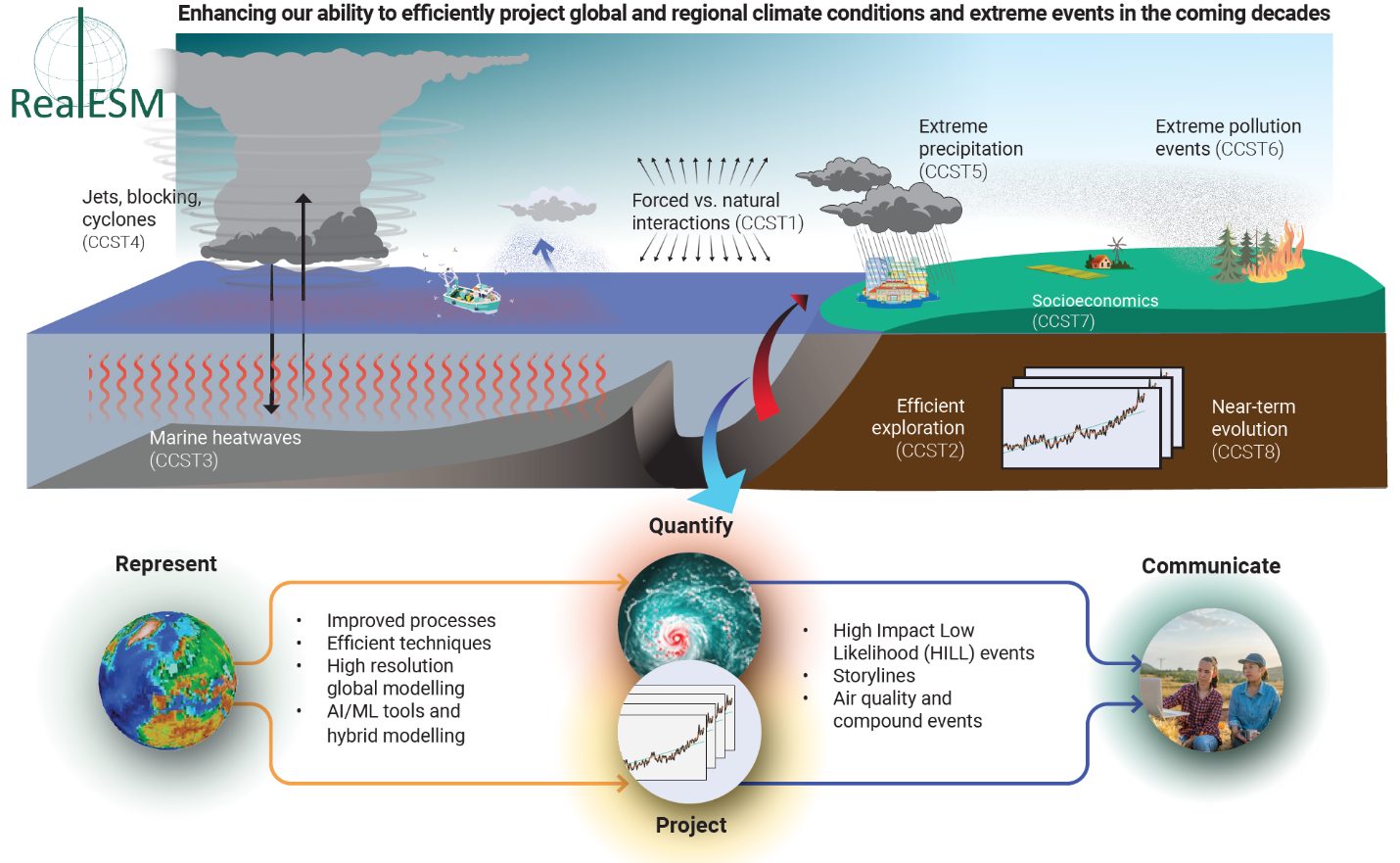
The climate is the result of a complex interplay between the atmosphere, the ocean, the land surface, and natural variations in the weather. As the world warms in response to our greenhouse gas emissions, all of these factors change.
The most damaging consequences come when several changes pull in the same direction, leading to record breaking extreme events or long periods of rapid changes. However, these are also still the most difficult for scientists to foresee.
RealESM will provide information to adaptation planners and businesses on how the climate can evolve in the coming decades, and how we can have advance warning of particularly rapid period of change.
To do this, we work with, and improve on, the best available climate models, combined with expert knowledge on how the ocean and the atmosphere interact to produce unusual – or even unprecedented – weather conditions. We bring together experts from ten major European climate research institutions, with expertise on modelling, observations, climate impacts, communication, and more.
RealESM has four unifying aims:
Represent the interaction between the atmosphere and the ocean more realistically in current numerical models
Efficiently use current and future models to produce a wider set of future conditions for use as stress testing by the wider community
Quantify key impacts of climate change over the coming decades, notably extreme weather and extreme air pollution events
Communicate how the climate is likely to change, and what surprises are possible, in a way that is tangible and actionable for adaptation planners
The main scientific challenge tackled by RealESM is to improve knowledge of the interactions between the atmosphere and the ocean, in general, and how they change as the climate warms. We take as a starting point four major European-led climate models; NorESM, ICON, EC-Earth and IFS; and will deliver both technical improvements and datasets for use by scientists and the wider community.
To make the model results tangible, RealESM focuses on a set of science topics known to be directly or indirectly critical for how a changing climate impacts society, and how we can foresee surprises:
How human-induced climate change interacts with natural variations in the weather, from years to decades
How climate models can be used more efficiently, so that we can rapidly deliver new information as the climate evolves and surprises occur
How marine heatwaves evolve and influence society
How cyclones, atmospheric jets, and blocking phenomena, evolve in a warmer world
How extreme precipitation evolves in different regions, in response to changes in the ocean and atmosphere
How natural and human air pollutant emissions can combine to create extreme pollution events
How regional changes in weather conditions lead to socio-economic impacts and damages
How the climate evolves over the coming decades, in different regions of the world, and how this can differ from the oft-cited global average
A central feature of RealESM is the development of a set of "stressful futures". These are fleshed out storylines of future climate evolution that are realistic, but would be surprising, and therefore potentially highly damaging, if they were to occur. These can be used as stress tests by other parts of the scientific community, and by adaptation planners and businesses when making strategies for the coming decades.
The RealESM External Advisory Board, which oversees our operations, consists of prominent scientists from around the world:
Dr. Clara Deser, NCAR, US
Prof. Paul Edwards, Stanford University, US / Institute for Advanced Study, Amsterdam, Netherlands
Prof. Seita Emori, University of Tokyo, Japan
Prof. Gabi Hegerl, University of Edinburgh, UK
Dr. Blair Trewin, Bureau of Meteorology, Australia